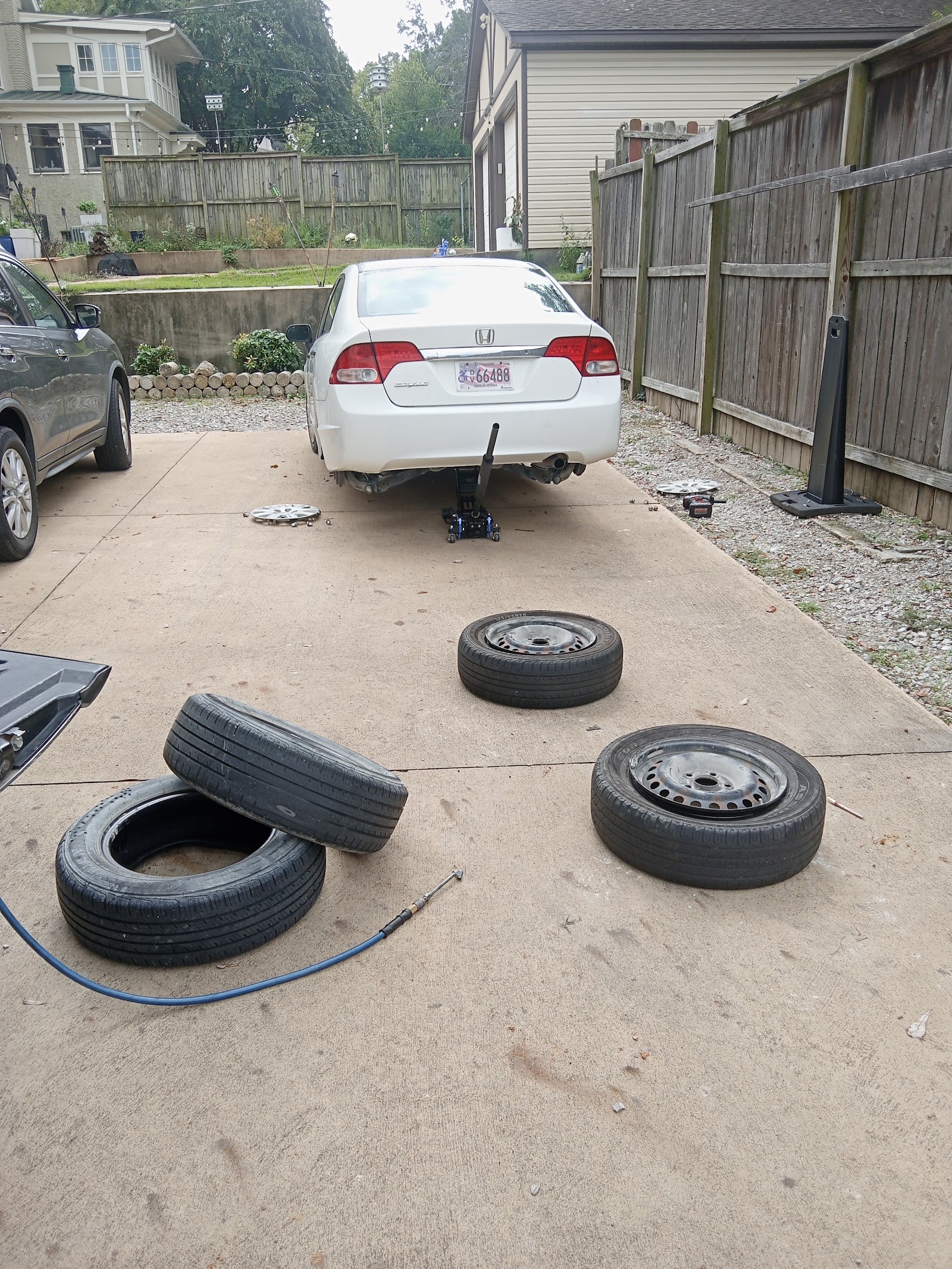
Pull over to a safe spot
The moment you realize you have a flat tire, stay calm and don't slam on the brakes. Gradually slow down and pull over to a safe location as far from traffic as possible. A flat, level surface is ideal, and if you're on a highway, get onto the shoulder or an exit ramp. Avoid stopping in a curve or near a blind spot where other drivers might not see you. Turn on your hazard lights to alert other motorists.
If you're on a busy road, stay in your vehicle with your seatbelt on until help arrives. If you have reflective triangles or flares, place them behind your car to warn approaching traffic. Call for roadside assistance or a mobile tire service. Our shop can come to your location, assess the tire, and either repair it or replace it on the spot. Don't attempt to change the tire yourself if you're not comfortable or if the conditions are unsafe.
Assess the damage
Once you're safe, take a look at the flat tire. Determine whether it's completely flat or just low on air. If it's low, you may be able to inflate it and drive to a nearby service, but if it's flat, you'll need a repair or replacement. Check for visible punctures, cuts, or objects stuck in the tread. Look at the sidewall for bulges or cracks, these indicate the tire may be too damaged to repair.
If you have a spare tire and the tools, you can change it yourself, but only if you're on solid ground and feel confident. Otherwise, wait for professional help. A mobile tire service will have the equipment to handle the job safely, including a jack, lug wrench, and a proper torque wrench to tighten the lug nuts to spec. They'll also inspect the tire thoroughly to determine if a repair is possible or if you need a replacement.
Decide between repair and replacement
Not all flats are created equal. A puncture in the tread area, such as from a nail, can often be repaired if the hole is small and the tire hasn't been driven on while flat. The repair involves removing the tire from the wheel, inspecting the inside for damage, and plugging and patching the hole from the inside. This is a permanent repair that can extend the life of the tire. However, if the tire has been driven on flat, the sidewall may be damaged, and the tire must be replaced.
The location of the puncture is also critical. Punctures in the sidewall or shoulder are not repairable because the flexing of those areas can cause the patch to fail. Similarly, if there are multiple punctures close together, the tire's integrity is compromised. Our shop will check the tire's tread depth and overall condition. If the tire is already worn or old, replacement is often the safer and more cost-effective choice.
Temporary fixes: sealants and spares
You might have a can of tire sealant in your trunk, but these are only a temporary solution. Sealants can fill small punctures in the tread and allow you to drive to a service station, but they are not a permanent repair. They also make it harder to professionally repair the tire later, because the sealant can interfere with the patch's adhesion. Use sealants only as a last resort to get off the highway, and then have the tire inspected as soon as possible.
A spare tire, whether full-size or a compact temporary, is also a temporary fix. A compact spare, often called a donut, is designed for short distances at reduced speeds, usually no more than 50 miles and 50 mph. Full-size spares are better but still should be checked for proper inflation. If you use a spare, have the flat tire repaired or replaced promptly. Our mobile service can install the spare for you and then take the damaged tire to be repaired, or we can bring a new tire to replace it right away.
Prevent future flats
The best way to deal with a flat tire is to avoid one in the first place. Check your tire pressure monthly, including the spare, and keep it at the manufacturer's recommended level. Underinflated tires are more prone to punctures and blowouts. Inspect your tires regularly for cuts, bulges, and embedded objects. Rotate your tires as recommended in your owner's manual to ensure even wear, which reduces the risk of failure.
If you hit a pothole or curb, have your tires inspected for damage, even if they look fine. Internal damage can lead to a sudden flat later. Also, be mindful of your load, overloading your vehicle puts extra stress on the tires. By staying on top of maintenance, you can reduce the chance of a flat. But if one happens, you know what to do: stay safe, call for help, and get a professional assessment. Our shop is ready to come to you, wherever you are in Memphis, to get you back on the road.